

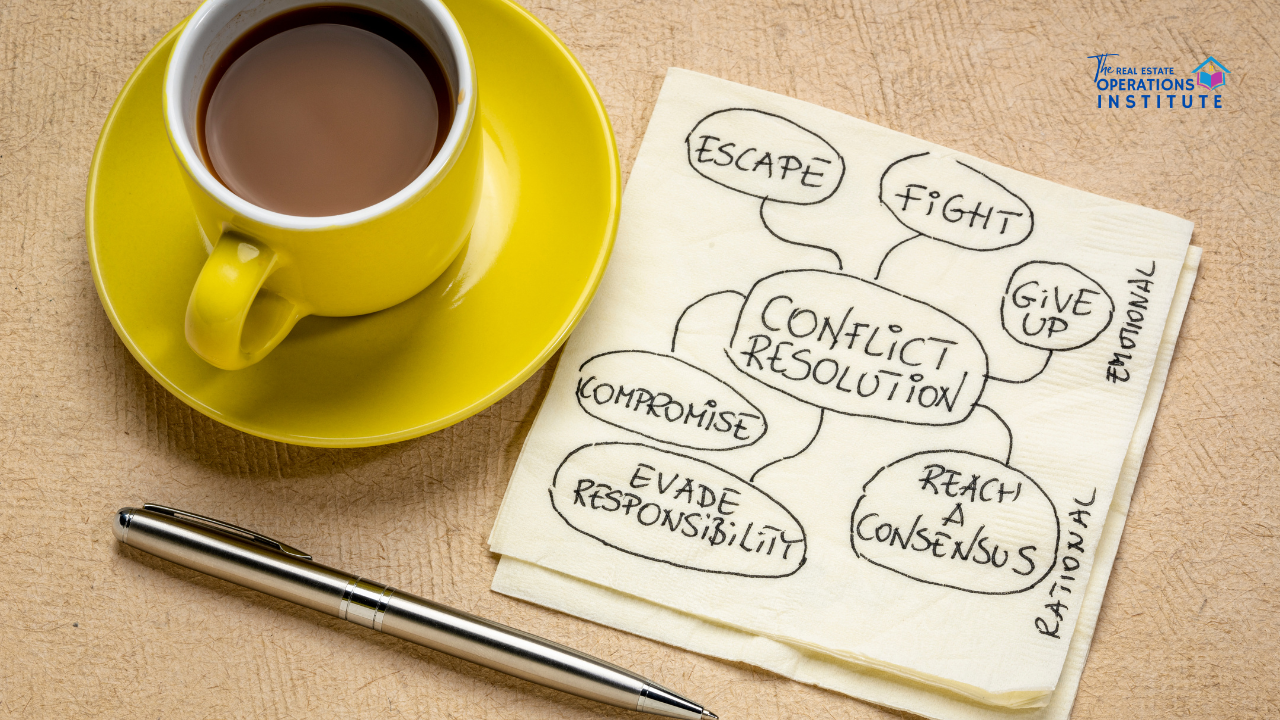
Conflict Resolution in Real Estate: Turning Friction Into Forward Motion
Real estate is a relationship business, and anywhere you have relationships, you're going to have friction.
Agents disagree. Buyers and sellers have different priorities. An Operations Manager and Transaction Coordinator may have completely different ideas about how something should be handled. Brokers have to navigate personalities, policies, expectations, and emotions, sometimes all before lunch.
But conflict itself isn't necessarily the problem.
The bigger problem is how we respond to it.
One of the ideas that stood out to us from the TEDx Talk The Secret to Conflict Resolution is how easily we get stuck looking at a situation through our own lens. We know what we meant. We know what we experienced. We know why we're frustrated.
And naturally, we assume our version is the version.
Conflict resolution requires us to get curious enough to consider that someone else may be experiencing the exact same situation very differently.
That doesn't mean they're right and you're wrong. It means understanding has to come before resolution.
When Conflict Happens in a Transaction
Real estate transactions are practically built for conflict.
There are deadlines, money, emotions, contracts, inspections, appraisals, repairs, commissions, and multiple people trying to protect different interests.
An inspection negotiation goes sideways. One agent feels like the other isn't communicating. A buyer thinks the seller should obviously make a repair. The seller thinks the buyer is being unreasonable.
Before long, everyone is defending their position instead of trying to solve the problem.
That's when we have to separate what happened from how we feel about what happened.
Ask:
What are the facts?
What does the contract actually say? What happened? What was communicated?
What are the feelings?
What emotions are influencing how everyone is responding?
What are the interests?
What does each party actually need or want?
What are the options?
What solutions are available that could move the transaction forward?
Sometimes the best conflict-resolution skill an agent can develop is simply learning to stop asking, "How do I prove I'm right?" and start asking, "How do we solve this?"
When Conflict Happens Behind the Scenes
Here's the conflict we don't talk about nearly enough.
Operations.
An Operations Manager thinks a Transaction Coordinator isn't following the process. The TC thinks the Operations Manager is micromanaging.
A Listing Coordinator is frustrated because agents aren't submitting information on time. The agent is frustrated because they feel like they're being asked for the same information three different times.
The admin thinks, "Why can't they just follow the system?"
The agent thinks, "Why does everything have to be so complicated?"
Sound familiar?
Here's the funny part: both people may actually want the exact same thing.
They want the transaction handled correctly. They want the client taken care of. They want fewer mistakes. They want the business to run smoothly.
They're just viewing the problem from different seats.
Instead of immediately defending the process or blaming the person, get curious.
"Walk me through what happened from your perspective."
"Where did the process break down for you?"
"What were you trying to accomplish?"
"Is this a people problem, a communication problem, or a systems problem?"
That last question is especially important in operations.
Because sometimes conflict is actually data.
If your team keeps arguing about the same thing, there may be a workflow that needs clarification, an SOP that needs updating, a responsibility that hasn't been clearly assigned, or an expectation that everyone interpreted differently.
Don't just resolve the disagreement.
Fix what keeps creating it.
When You're the Agent in the Conflict
Agents aren't exempt from this either.
You may disagree with your TC, Ops Manager, assistant, broker, team lead, or another agent.
And sometimes your frustration is completely valid.
But being frustrated doesn't automatically make your response productive.
Before firing off the text, sending the email, or calling five other agents to tell them what happened, ask yourself:
What outcome am I actually trying to achieve?
Do I want a solution?
Do I want clarity?
Do I want something to change?
Or do I just want someone to agree that I'm right?
Those are very different goals.
You can advocate for yourself without attacking someone else. You can disagree without being disrespectful. And you can hold someone accountable while still leaving room to understand their perspective.
That's a professional skill, and in today's real estate market, it's becoming increasingly important.
When You're Leading Through Conflict
Leadership adds another layer because you're often not one of the people in the conflict.
You're the person everyone brings it to.
The temptation is to immediately determine who's right and who's wrong.
But good leaders don't just referee the disagreement. They look underneath it.
What actually happened?
What does each person believe happened?
Where did expectations differ?
Was the process clear?
And most importantly:
What needs to happen next?
Sometimes resolution means having a difficult conversation. Sometimes it means reinforcing a boundary. Sometimes someone needs coaching. And sometimes leadership has to acknowledge that the system created the problem.
The goal isn't always to make everyone happy.
The goal is to create enough clarity that everyone knows how to move forward.
From Conflict to Curiosity
The next time you find yourself in conflict, try changing the questions you're asking.
Instead of:
"Why would they do that?"
Try:
"What might I be missing?"
Instead of:
"How do they not understand this?"
Try:
"Have we actually made the expectation clear?"
Instead of:
"Who's right?"
Try:
"What needs to happen for us to move forward?"
That doesn't mean ignoring bad behavior, avoiding accountability, or compromising your standards.
It means recognizing that resolution usually starts when we stop preparing our rebuttal long enough to understand what's actually happening.
The Bigger Picture
Real estate will always have conflict because real estate will always involve people.
And people bring different experiences, communication styles, expectations, pressures, and perspectives into the room.
The goal isn't to create a business where nobody disagrees.
The goal is to create a business where disagreement doesn't derail the mission.
For agents, that means becoming better problem-solvers.
For operations professionals, it means building clearer systems and communication.
For leaders, it means creating an environment where people can disagree, address the issue, learn from it, and move forward.
Because friction isn't always a sign that something is failing.
Sometimes it's showing you exactly where your business needs to get better.
And when we stop treating conflict like something we need to win, we can finally start using it as something we can learn from.
Author: Carissa Mason
Stay In The Know!
Subscribe to our newsletter to get exclusive resources, class alerts, motivation, tips, and other helpful information delivered right to your inbox.
(Don't worry, we don't spam you!)
